
guide
Why Serial Numbers and Asset Photos Matter for Insurance
Learn how serial numbers and equipment photos support insurance schedules, theft reports, proof of ownership, condition records, and claims.
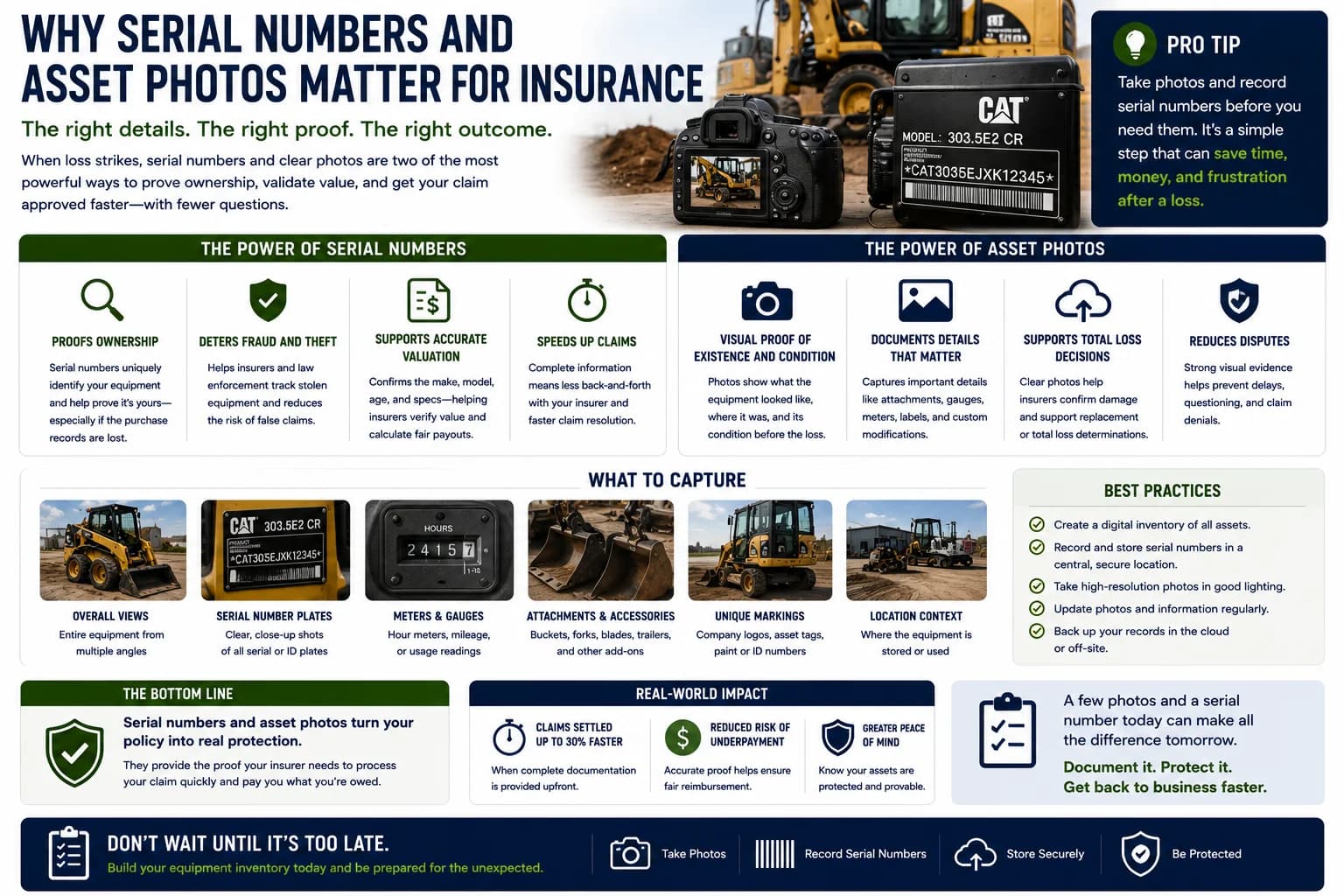
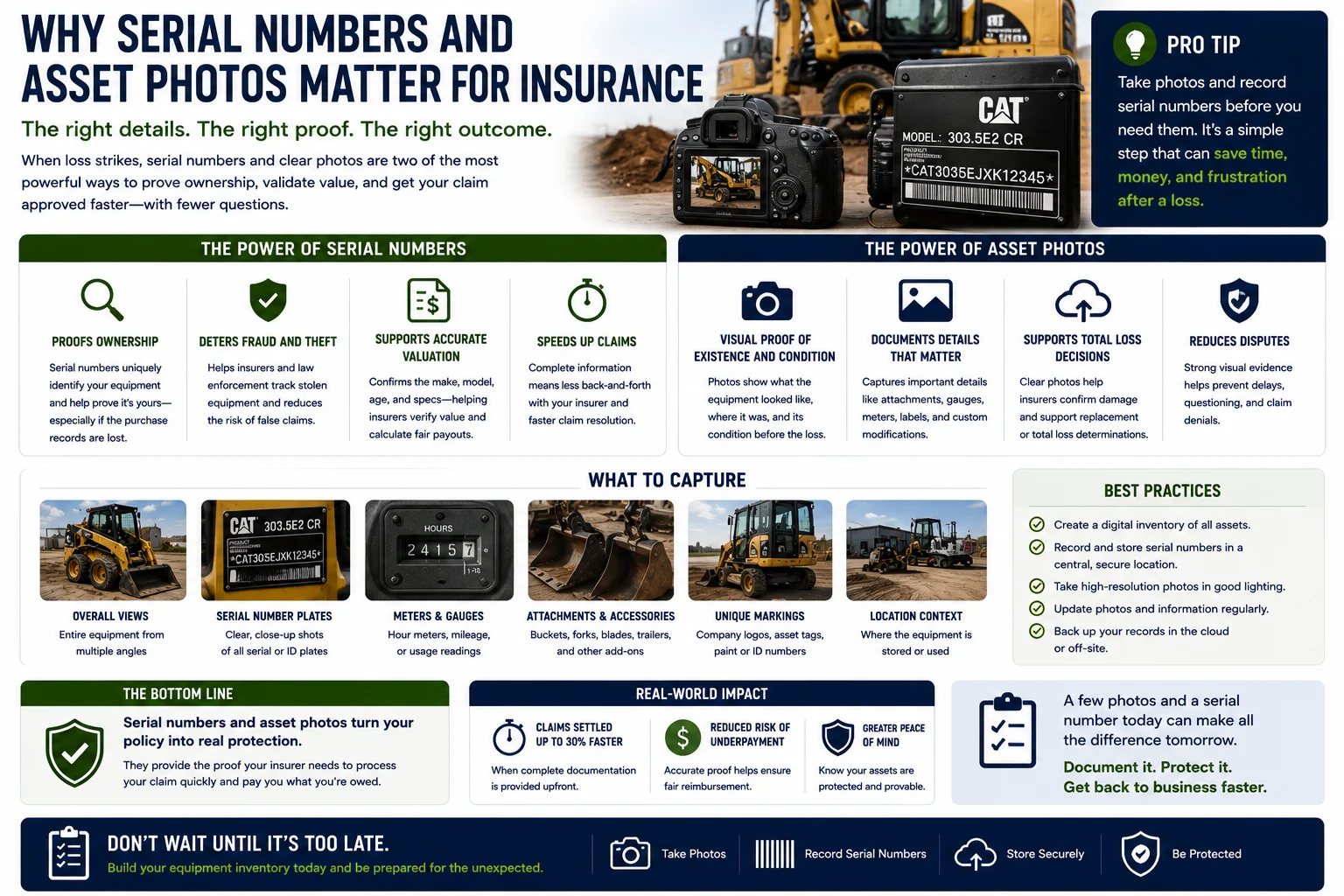
Introduction
A list that says "generator," "laptop," or "skid steer" may not be enough to identify lost or damaged equipment. Insurers, police, vendors, and recovery teams often need details that distinguish one asset from another.
Serial numbers and asset photos create that connection. Together, they help establish identity, ownership, condition, location, and the exact equipment involved in a loss.
This article is general educational information. Claim requirements vary by insurer and policy.
Why Serial Numbers Matter
A serial number is a manufacturer-assigned identifier for a specific asset.
It can help:
- Distinguish similar equipment
- Confirm ownership records
- Match invoices to assets
- Support police reports
- Check warranty history
- Identify recovered property
- Prevent duplicate records
For vehicles and trailers, a VIN or registration number may serve a similar role.
Why Asset Photos Matter
Photos show details that text records may miss.
Useful photos can document:
- Overall appearance
- Serial plate
- Asset tag
- Attachments
- Existing damage
- Company markings
- Storage location
- Condition before a loss
Photos also help adjusters understand the equipment when an in-person inspection is difficult.
The Best Photo Set
For each asset, capture:
- Full front or side view.
- Opposite side or rear view.
- Serial plate close-up.
- Asset tag close-up.
- Attachments and accessories.
- Existing damage or modifications.
- Meter or odometer reading when relevant.
Photos should be clear, well lit, and current.
Avoid Serial Number Errors
Serial numbers can be difficult to read.
Best practices include:
- Photograph the identification plate
- Enter the number into the asset record
- Compare the typed value with the photo
- Preserve leading zeros
- Distinguish letters from numbers
- Record manufacturer and model nearby
A photo provides a reference if the typed number is questioned.
Supporting Theft Claims
After theft, serial numbers can be included in:
- Police reports
- Insurance claims
- Stolen-property databases
- Vendor notices
- Recovery documentation
Generic descriptions are less useful for identifying recovered equipment.
Supporting Damage Claims
Pre-loss photos can show:
- Equipment existed
- General condition
- Included attachments
- Prior damage
- Company ownership markings
Post-loss photos can then document what changed.
Keep Records Current
Update photos when:
- Equipment is purchased
- Major attachments are added
- A rebuild is completed
- Condition changes
- Equipment moves to a long-term location
- The asset is sold or retired
Old photos may not reflect current value or configuration.
Storage and Backup
Do not keep the only copy on a device or server located with the equipment.
Use:
- Cloud storage
- Secure asset management software
- Off-site backups
- Controlled access
- Regular exports
Records should remain available after a local disaster.
Serial Number and Photo Checklist
For every insured asset, record:
- Asset ID
- Manufacturer
- Model
- Serial number
- Serial plate photo
- Full equipment photos
- Attachment photos
- Condition notes
- Location
- Purchase invoice
- Last review date
This creates a stronger insurance-ready asset file.
Conclusion
Serial numbers and asset photos are simple records with significant value. They help identify equipment, prove ownership, document condition, support theft reports, and clarify insurance claims.
Capturing this information at acquisition takes only a few minutes and can save considerable time after a loss.