
guide
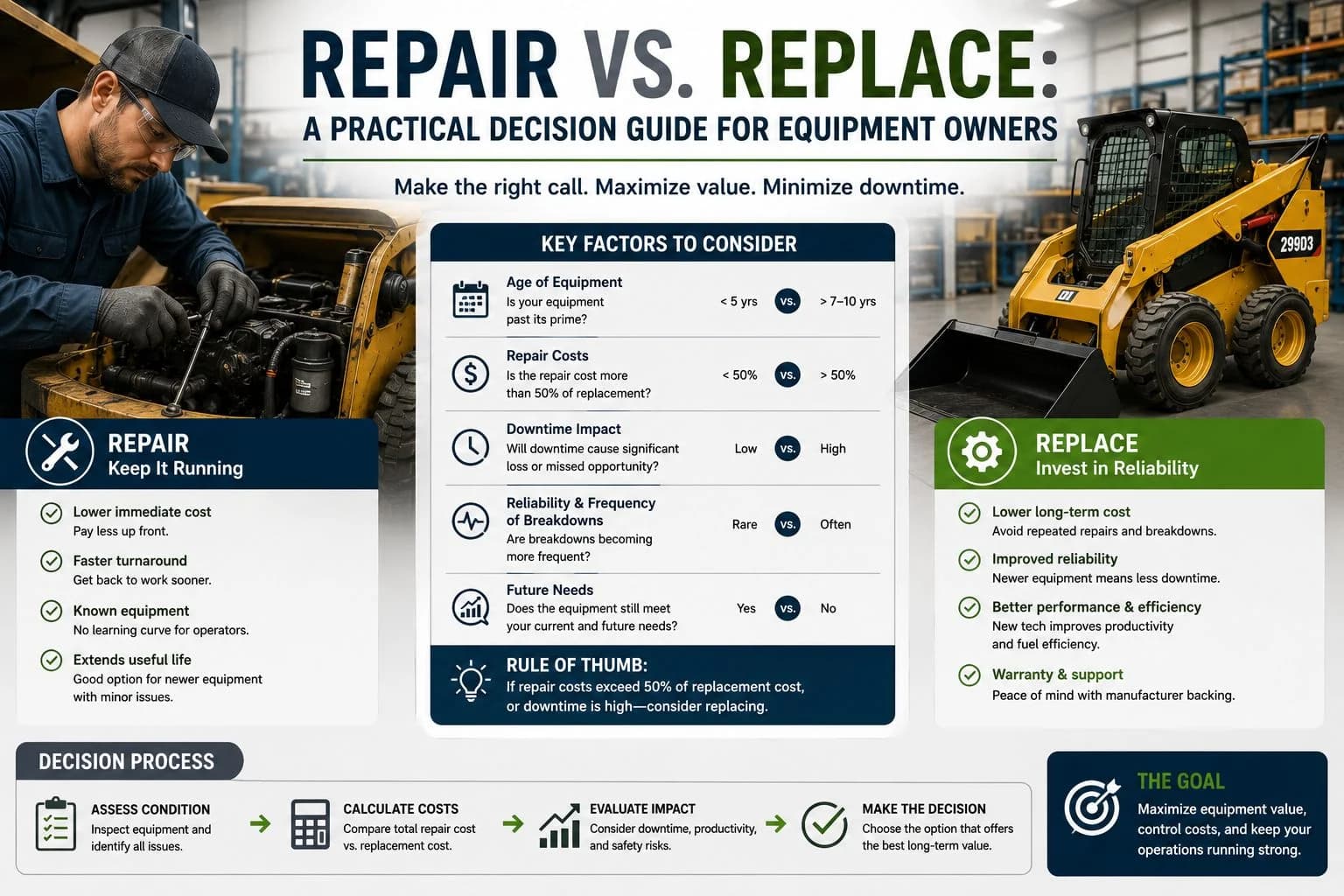
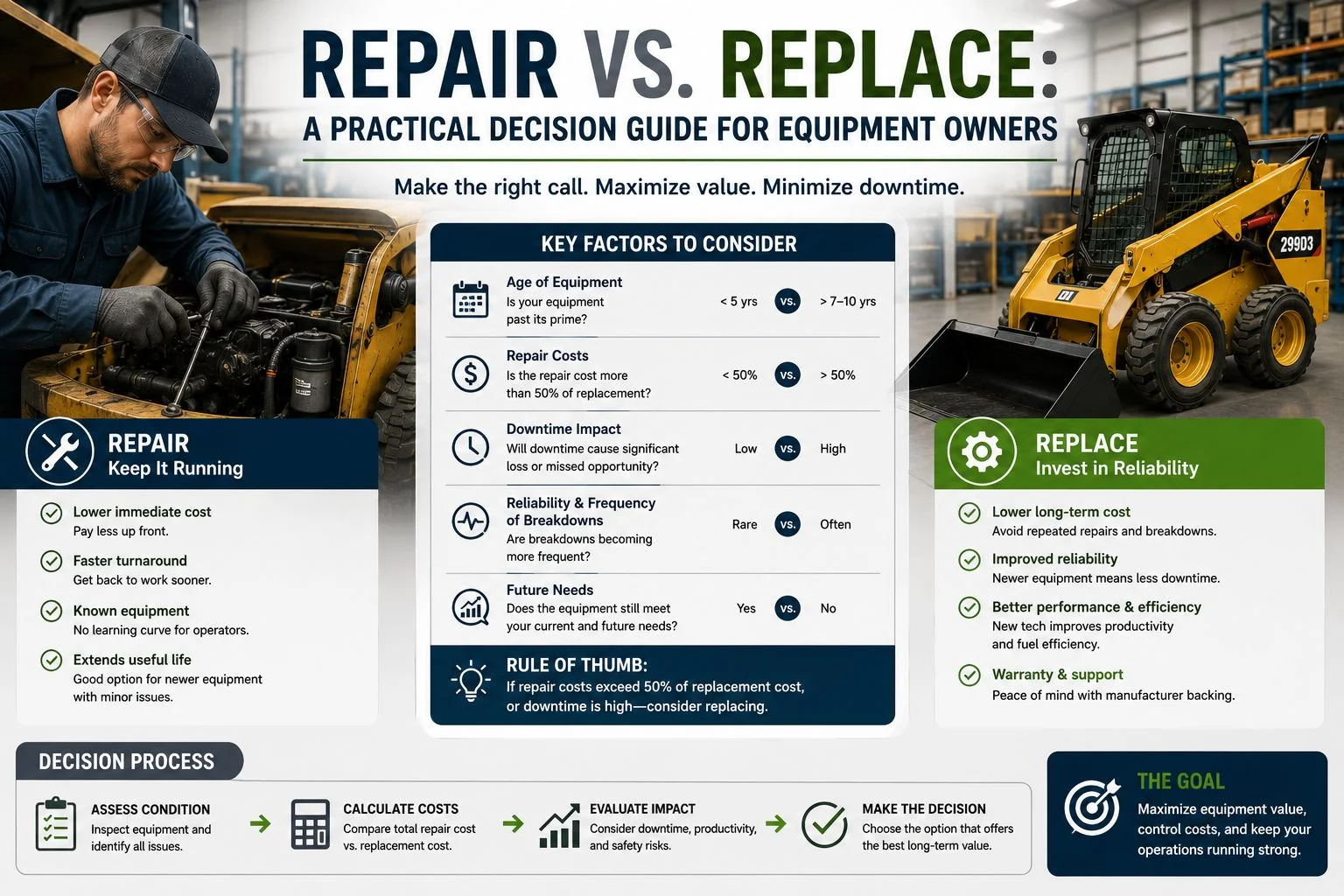
Repair vs. Replace: A Practical Decision Guide for Equipment Owners
Use this practical repair-versus-replace framework to evaluate equipment service history, downtime, repair costs, safety, replacement value, and total cost of ownership.
Introduction
Every business eventually faces the same question: should we repair this equipment or replace it?
Whether it's a skid steer, CNC machine, forklift, service truck, air compressor, excavator, medical device, or production machine, there comes a point when maintenance costs begin to rise and reliability begins to decline. Making the wrong decision can be expensive.
Repairing equipment too long can result in repeated downtime, rising maintenance costs, and lost productivity. Replacing equipment too early can waste capital and reduce return on investment.
The goal is not simply to choose the cheapest option today, but to determine which option creates the best long-term value for the business.
This guide outlines a practical framework for evaluating repair-versus-replace decisions and helps organizations make informed, data-driven equipment management decisions.
Why the Decision Matters
Equipment is often one of the largest investments a business makes.
A poor decision can lead to:
- Increased operating costs
- Higher maintenance expenses
- Unexpected downtime
- Reduced productivity
- Safety concerns
- Lower profitability
A structured decision-making process removes emotion and focuses on measurable business factors.
Start With the Equipment's Service History
Before making any decision, review the equipment's service records.
Key questions include:
- How often is the equipment breaking down?
- How much has been spent on repairs during the last year?
- Is downtime increasing?
- Are failures becoming more frequent?
- Are the same components failing repeatedly?
Equipment with a long history of recurring issues may indicate a larger underlying problem.
Historical service data often provides the clearest picture of future reliability.
Calculate Total Annual Repair Costs
One repair bill alone should not determine whether equipment is replaced.
Instead, evaluate total maintenance and repair expenses over time.
Include:
- Repair labor
- Replacement parts
- Service contracts
- Emergency service fees
- Rental equipment costs
- Overtime labor caused by breakdowns
Many businesses underestimate the true cost of keeping aging equipment operational.
When annual repair costs continue increasing year after year, replacement may become the better financial decision.
Evaluate Equipment Age
Age alone should not determine replacement, but it remains an important consideration.
Ask:
- How old is the equipment?
- Has it exceeded its expected service life?
- Is the technology outdated?
- Are replacement parts still available?
Some equipment remains productive for decades when properly maintained, while other equipment becomes obsolete much sooner.
Age should be considered alongside performance and maintenance costs.
Consider Equipment Reliability
Reliability is often more important than repair cost.
A machine that costs $1,000 to repair once every five years is very different from a machine that costs $500 to repair every month.
Warning signs of declining reliability include:
- Frequent breakdowns
- Unexpected shutdowns
- Increasing service calls
- Production interruptions
- Difficulty diagnosing problems
When reliability declines significantly, replacement often becomes the better long-term solution.
Measure Downtime Costs
One of the most overlooked factors is the cost of downtime.
Ask:
- How much revenue is lost when equipment is unavailable?
- How many employees are affected?
- Are customer deadlines impacted?
- Does downtime stop production?
For critical equipment, downtime costs often exceed repair costs.
A machine that fails repeatedly may create much larger business losses than its repair invoices suggest.
Compare Repair Cost to Replacement Cost
A common rule used by many organizations is to compare the repair cost to the current replacement value.
Examples:
Repair May Make Sense
- Replacement Cost: $50,000
- Repair Cost: $2,500
Repair Cost = 5% of replacement value
Generally reasonable to repair.
Replace May Be Worth Considering
- Replacement Cost: $50,000
- Repair Cost: $20,000
Repair Cost = 40% of replacement value
Replacement should be seriously evaluated.
The 50 Percent Rule
Many businesses use a simple guideline:
If a repair exceeds approximately 50% of the equipment's current replacement value, replacement should be strongly considered.
This is not a strict rule but serves as a useful benchmark.
Evaluate Future Repair Risk
The current repair may not be the last repair.
Ask:
- What is likely to fail next?
- Are other major components nearing end of life?
- Is this repair addressing the root cause?
Replacing one major component in an aging machine may simply delay the next expensive repair.
Future risk should always be part of the decision.
Assess Parts Availability
As equipment ages, replacement parts often become harder to find.
Potential issues include:
- Long lead times
- Discontinued components
- Limited suppliers
- Increasing part costs
Equipment that cannot be repaired quickly due to parts shortages may justify replacement sooner.
Consider Safety Risks
Safety should never be compromised to extend equipment life.
Evaluate:
- Structural integrity
- Safety systems
- Compliance requirements
- Operational hazards
Equipment that presents ongoing safety concerns should be repaired immediately or replaced if necessary.
Evaluate Technology Improvements
Newer equipment often offers significant advantages.
Potential benefits include:
- Higher productivity
- Lower fuel consumption
- Improved efficiency
- Better safety features
- Reduced maintenance requirements
- Enhanced reporting capabilities
Sometimes replacement is justified not because old equipment is unusable, but because newer technology provides substantial business benefits.
Calculate Total Cost of Ownership
The best decisions consider total ownership costs rather than repair costs alone.
Include:
- Purchase price
- Financing costs
- Fuel or energy consumption
- Maintenance expenses
- Repair history
- Downtime costs
- Insurance costs
Total cost of ownership provides a more complete picture of equipment value.
Questions to Ask Before Replacing Equipment
Before making a replacement decision, consider:
- Does the equipment still meet operational needs?
- Is downtime increasing?
- Are repair costs escalating?
- Is reliability declining?
- Are parts becoming difficult to obtain?
- Are newer alternatives significantly more efficient?
- Does the equipment present safety concerns?
The more "yes" answers you have, the stronger the case for replacement.
Questions to Ask Before Repairing Equipment
Repairing may be the better choice when:
- The equipment is relatively new.
- Repair costs are low.
- Reliability remains strong.
- Downtime is minimal.
- Parts are readily available.
- The repair addresses the root cause.
- The equipment continues to meet business requirements.
Not every repair indicates replacement is necessary.
Warning Signs That Replacement Is Approaching
Businesses should begin evaluating replacement when they notice:
- Multiple major repairs per year
- Rising maintenance costs
- Increasing downtime
- Decreasing productivity
- Obsolete technology
- Difficulty obtaining parts
- Reduced equipment value
- Safety concerns
These indicators often signal the later stages of the equipment lifecycle.
Building a Replacement Strategy
Organizations should avoid waiting for catastrophic failure.
Instead:
Track Service History
Maintain detailed maintenance records.
Monitor Costs
Review repair and maintenance expenses regularly.
Budget for Replacement
Create long-term equipment replacement plans.
Prioritize Critical Equipment
Replace essential assets before failures disrupt operations.
Proactive planning often reduces overall costs.
Repair vs. Replace Decision Checklist
Consider the following:
- Current repair cost
- Annual maintenance costs
- Equipment age
- Reliability history
- Downtime impact
- Safety concerns
- Parts availability
- Productivity improvements
- Replacement cost
- Total cost of ownership
Using a structured checklist helps eliminate guesswork.
Conclusion
The decision to repair or replace equipment should never be based on a single repair invoice. Effective decisions require evaluating maintenance history, downtime costs, reliability, safety, replacement value, and future business needs.
In many cases, repairing equipment remains the most cost-effective option. However, when maintenance costs continue rising, reliability declines, and downtime begins affecting operations, replacement may provide greater long-term value.
Organizations that track equipment performance, maintain detailed service records, and plan replacements proactively are better positioned to maximize asset value while minimizing operational disruptions.