
guide
Preventive Maintenance Programs: How to Extend Equipment Life and Reduce Downtime
Learn how preventive maintenance programs reduce downtime, lower repair costs, improve safety, and extend equipment life with structured schedules and service records.
Introduction
Equipment failures rarely happen without warning. In most cases, breakdowns are the result of wear, neglected inspections, missed service intervals, or small issues that gradually develop into major problems.
For businesses that rely on equipment to generate revenue, unexpected downtime can be costly. Repairs often involve emergency service calls, production delays, missed deadlines, and lost productivity.
A preventive maintenance program helps organizations avoid these problems by performing routine maintenance before failures occur.
Whether managing CNC machines, drill presses, lathes, forklifts, welding equipment, air compressors, fleet vehicles, or manufacturing machinery, preventive maintenance is one of the most effective ways to improve equipment reliability and maximize asset value.
This guide explains what preventive maintenance programs are, why they matter, and how businesses can build an effective maintenance strategy.
What Is Preventive Maintenance?
Preventive maintenance (PM) is the practice of performing scheduled inspections, servicing, and maintenance activities before equipment fails.
Rather than waiting for a breakdown, maintenance tasks are completed at planned intervals based on:
- Time
- Usage hours
- Production cycles
- Manufacturer recommendations
- Equipment condition
The objective is to prevent failures, extend equipment life, and reduce operating costs.
Why Preventive Maintenance Matters
Many businesses operate using a reactive maintenance approach.
This means equipment is only repaired after it breaks.
While this may seem cost-effective initially, reactive maintenance often leads to:
- Increased downtime
- Higher repair costs
- Reduced equipment lifespan
- Lost productivity
- Safety risks
- Unpredictable expenses
Preventive maintenance helps businesses stay ahead of problems rather than constantly reacting to them.
Benefits of a Preventive Maintenance Program
Reduced Equipment Downtime
One of the primary goals of preventive maintenance is minimizing unexpected failures.
Regular inspections help identify issues before they result in equipment outages.
Benefits include:
- Fewer breakdowns
- Better production planning
- Improved operational reliability
Less downtime means more productive equipment.
Lower Repair Costs
Minor maintenance tasks are generally much less expensive than major repairs.
Examples:
- Replacing a worn belt costs significantly less than replacing a damaged motor.
- Changing hydraulic fluid costs less than rebuilding a hydraulic system.
Preventive maintenance reduces costly emergency repairs.
Extended Equipment Lifespan
Equipment represents a significant investment.
Proper maintenance helps protect that investment by reducing wear and preventing premature failure.
Well-maintained equipment often remains productive years longer than neglected equipment.
Improved Workplace Safety
Equipment failures can create safety hazards for employees and operators.
Preventive maintenance helps identify:
- Worn components
- Loose hardware
- Fluid leaks
- Electrical issues
- Damaged safety systems
Addressing these issues proactively improves workplace safety.
Better Equipment Performance
Equipment that receives routine maintenance typically performs more efficiently.
Benefits may include:
- Increased productivity
- Better accuracy
- Improved fuel efficiency
- Reduced energy consumption
- Consistent operation
Maintenance supports optimal performance.
Types of Preventive Maintenance
Not all maintenance schedules are the same.
Different assets may require different approaches.
Time-Based Maintenance
Maintenance is performed at fixed intervals.
Examples:
- Weekly inspections
- Monthly servicing
- Quarterly maintenance
- Annual inspections
This is one of the most common maintenance methods.
Usage-Based Maintenance
Maintenance occurs after a specific amount of use.
Examples:
- Every 250 operating hours
- Every 5,000 miles
- Every 10,000 production cycles
This approach aligns maintenance with actual equipment usage.
Manufacturer-Recommended Maintenance
Manufacturers often provide maintenance schedules.
Examples include:
- Lubrication intervals
- Filter replacement schedules
- Inspection requirements
- Fluid change intervals
Following manufacturer recommendations helps maintain performance and warranty compliance.
Condition-Based Maintenance
Maintenance is triggered by equipment condition.
Monitoring may include:
- Vibration analysis
- Temperature monitoring
- Oil analysis
- Performance indicators
Condition-based maintenance helps identify problems before failure occurs.
Building a Preventive Maintenance Program
Creating an effective program requires planning and consistency.
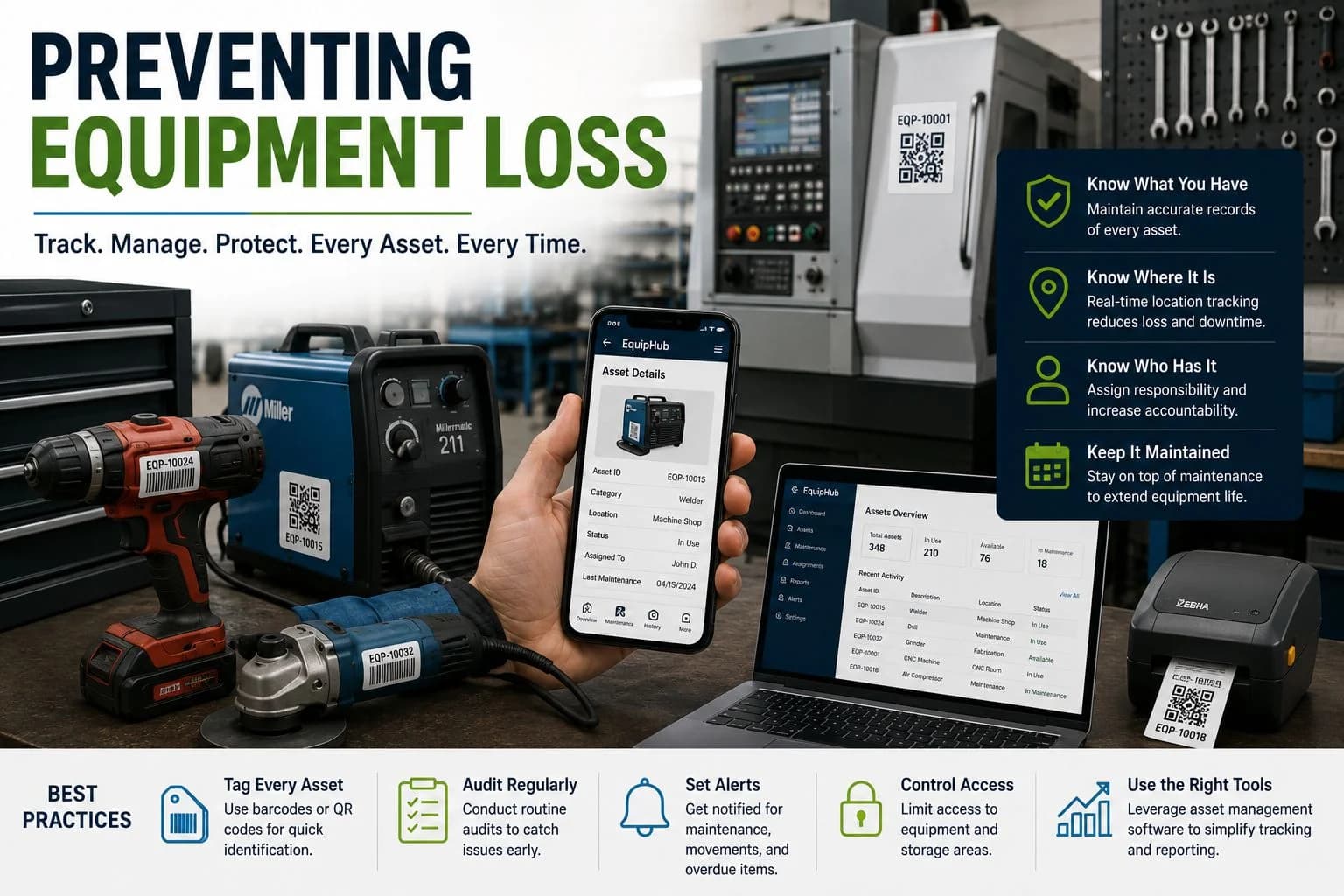
Step 1: Create an Asset Inventory
Start by identifying all equipment that requires maintenance.
Asset records should include:
- Asset ID
- Equipment name
- Manufacturer
- Model number
- Serial number
- Purchase date
- Location
A complete inventory forms the foundation of the maintenance program.
Step 2: Prioritize Critical Equipment
Not all assets are equally important.
Critical equipment may include:
- Production machinery
- CNC equipment
- Forklifts
- Air compressors
- Revenue-generating assets
Prioritize maintenance efforts on equipment that has the greatest operational impact.
Step 3: Define Maintenance Tasks
Document required maintenance activities for each asset.
Examples include:
- Inspections
- Cleaning
- Lubrication
- Calibration
- Fluid replacement
- Belt replacement
- Filter replacement
Clearly defined tasks improve consistency.
Step 4: Establish Maintenance Intervals
Determine how often maintenance should occur.
Intervals may be based on:
- Time
- Usage
- Manufacturer recommendations
- Operating environment
Equipment operating in harsh environments often requires more frequent maintenance.
Step 5: Assign Responsibility
Every maintenance task should have a designated owner.
Responsibilities may be assigned to:
- Operators
- Maintenance technicians
- Supervisors
- Third-party service providers
Clear accountability improves program execution.
Step 6: Document Maintenance Activities
Every maintenance task should be recorded.
Maintenance records should include:
- Service date
- Work performed
- Parts used
- Technician name
- Equipment condition
- Follow-up recommendations
Documentation supports future planning and troubleshooting.
Common Preventive Maintenance Tasks
Most preventive maintenance programs include:
Inspections
Visual and operational inspections identify potential issues early.
Cleaning
Dust, debris, and contaminants accelerate wear.
Routine cleaning helps maintain performance.
Lubrication
Lubrication reduces friction and component wear.
Proper lubrication significantly extends equipment life.
Fluid Changes
Examples include:
- Hydraulic fluid
- Coolant
- Engine oil
- Gear oil
Regular fluid replacement protects equipment components.
Filter Replacement
Dirty filters restrict airflow and reduce efficiency.
Routine replacement improves performance and reliability.
Calibration
Precision equipment often requires periodic calibration to maintain accuracy.
Common examples include:
- CNC machines
- Measurement equipment
- Industrial controls
Measuring Preventive Maintenance Success
An effective maintenance program should be evaluated regularly.
Key performance indicators include:
Equipment Downtime
Downtime should decrease over time.
Maintenance Compliance
Track completion rates for scheduled maintenance activities.
Repair Costs
Emergency repair expenses should decline.
Equipment Lifespan
Well-maintained assets typically remain productive longer.
Failure Frequency
Unexpected failures should become less common.
Common Preventive Maintenance Mistakes
Organizations should avoid:
Skipping Scheduled Maintenance
Delayed maintenance often creates larger problems later.
Poor Documentation
Incomplete records reduce visibility and planning effectiveness.
Inconsistent Procedures
Maintenance tasks should be performed consistently.
Ignoring Minor Issues
Small problems frequently develop into major repairs.
Lack of Accountability
Clearly assign maintenance responsibilities.
Without ownership, maintenance often gets delayed.
Best Practices for Preventive Maintenance Programs
Successful organizations typically:
- Maintain complete asset records
- Follow documented maintenance schedules
- Track maintenance history
- Prioritize critical equipment
- Conduct regular inspections
- Use standardized procedures
- Monitor performance metrics
- Train maintenance personnel
- Continuously improve maintenance processes
These practices help maximize reliability and asset performance.
Preventive Maintenance Checklist
An effective program should include:
- Asset inventory
- Maintenance schedules
- Inspection procedures
- Service logs
- Assigned responsibilities
- Maintenance documentation
- Performance tracking
- Compliance monitoring
- Spare parts management
- Continuous improvement reviews
Together, these elements create a strong maintenance foundation.
Conclusion
Preventive maintenance programs are one of the most effective ways to reduce downtime, lower repair costs, improve safety, and extend equipment lifespan. By proactively servicing equipment before failures occur, organizations gain greater control over maintenance costs while improving operational reliability.
Whether managing a small machine shop or a large manufacturing facility, a structured preventive maintenance program helps protect equipment investments and ensures assets continue delivering value throughout their lifecycle.