
guide
How to Prove Ownership of Lost or Damaged Equipment
Learn which records can help establish ownership of business equipment after theft, loss, fire, storm damage, or another insurance claim.
Introduction
After equipment is stolen, destroyed, or severely damaged, proving ownership can become one of the first challenges in an insurance claim. The original asset may be gone, the serial plate may be unreadable, or purchase records may be stored in a damaged office.
Strong ownership documentation links the business to the specific asset and supports its identity, purchase history, and value.
Required evidence varies by insurer and claim. This article is general information. Consult the insurer and a licensed insurance professional.
What Is Proof of Ownership?
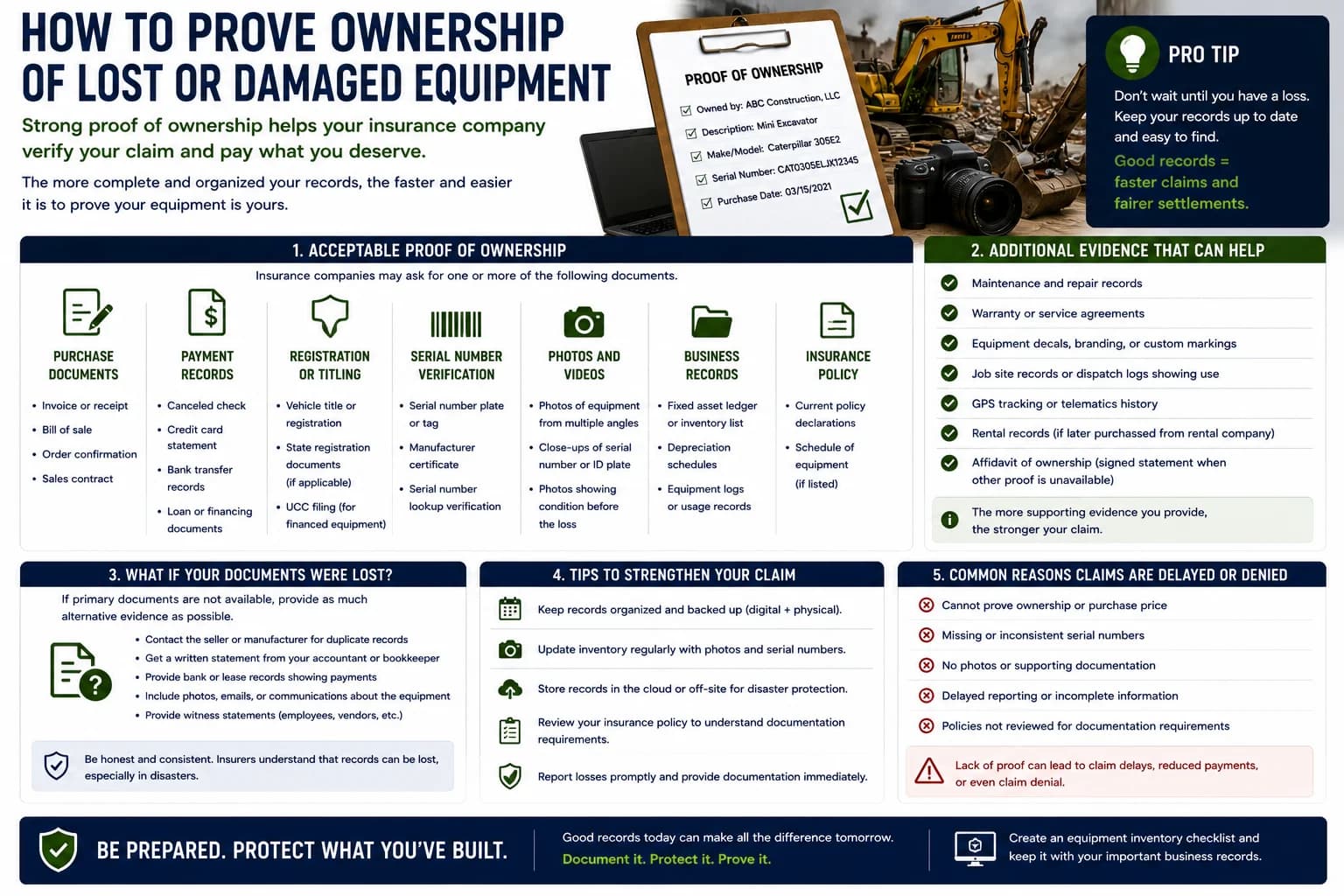
Proof of ownership is documentation showing that the business owned, leased, rented, or was otherwise responsible for the equipment.
No single document is always required. Claims may rely on several records that support one another.
Purchase Invoices and Receipts
Purchase records are often the strongest evidence.
Useful details include:
- Business name
- Vendor
- Purchase date
- Equipment description
- Model
- Serial number
- Purchase price
- Payment method
Keep digital copies attached to the asset record.
Financing and Lease Agreements
If equipment was financed or leased, agreements may show:
- Equipment description
- Serial number
- Purchase amount
- Borrower or lessee
- Lender or lessor
- Contract dates
The lender, leasing company, or dealer may retain copies.
Payment and Accounting Records
Supporting financial records may include:
- Canceled checks
- Bank statements
- Credit card statements
- General ledger entries
- Fixed asset schedules
- Depreciation records
- Tax records
These records can help confirm the transaction when an invoice is missing.
Serial Numbers and Asset Records
A serial number connects documents to a specific asset.
Maintain:
- Serial number
- Asset ID
- Manufacturer
- Model
- VIN where applicable
- Registration number
- Photos of identification plates
Typed serial numbers should be verified against a clear photo to prevent transcription errors.
Photos and Videos
Pre-loss photos can show:
- Equipment in the business's possession
- Asset tags
- Serial plates
- Attachments
- Condition
- Location
- Company markings
Photos are strongest when supported by invoices and asset records.
Service and Warranty Records
Maintenance vendors and manufacturers may have records tied to:
- Business name
- Serial number
- Service date
- Equipment model
- Warranty registration
These records can help reconstruct ownership history.
Registration and Government Records
For vehicles, trailers, or titled equipment, proof may include:
- Title
- Registration
- Permit
- Tax assessment
- Licensing record
Keep current and prior documents when ownership changes.
If Original Records Are Missing
Contact:
- Vendor or dealer
- Lender
- Leasing company
- Accountant
- Maintenance provider
- Manufacturer
- Insurance agent
- Registration authority
Ask for duplicate invoices, contracts, service records, or registration history.
Common Ownership Documentation Mistakes
Avoid:
- Receipts without equipment details
- Missing serial numbers
- Records stored only on site
- Asset names that are too generic
- Photos without identification plates
- Deleted records after equipment is retired
Multiple consistent records create stronger evidence.
Proof of Ownership Checklist
Maintain:
- Purchase invoice
- Payment record
- Financing or lease agreement
- Serial number
- Asset ID
- Photos
- Service records
- Warranty registration
- Accounting schedule
- Title or registration
Store backups in a secure, accessible location.
Conclusion
Proving ownership is easier when equipment records are created at acquisition rather than reconstructed after a loss. Invoices, payment records, serial numbers, photos, service history, and accounting records work together to identify the asset and connect it to the business.
A complete digital asset record can significantly reduce uncertainty during an insurance claim.