
guide
Barcode vs QR Code Tracking: Which Is Right for Your Business?
Compare barcode and QR code tracking for equipment management, including cost, scanning, data capacity, durability, and mobile workflows.
Introduction
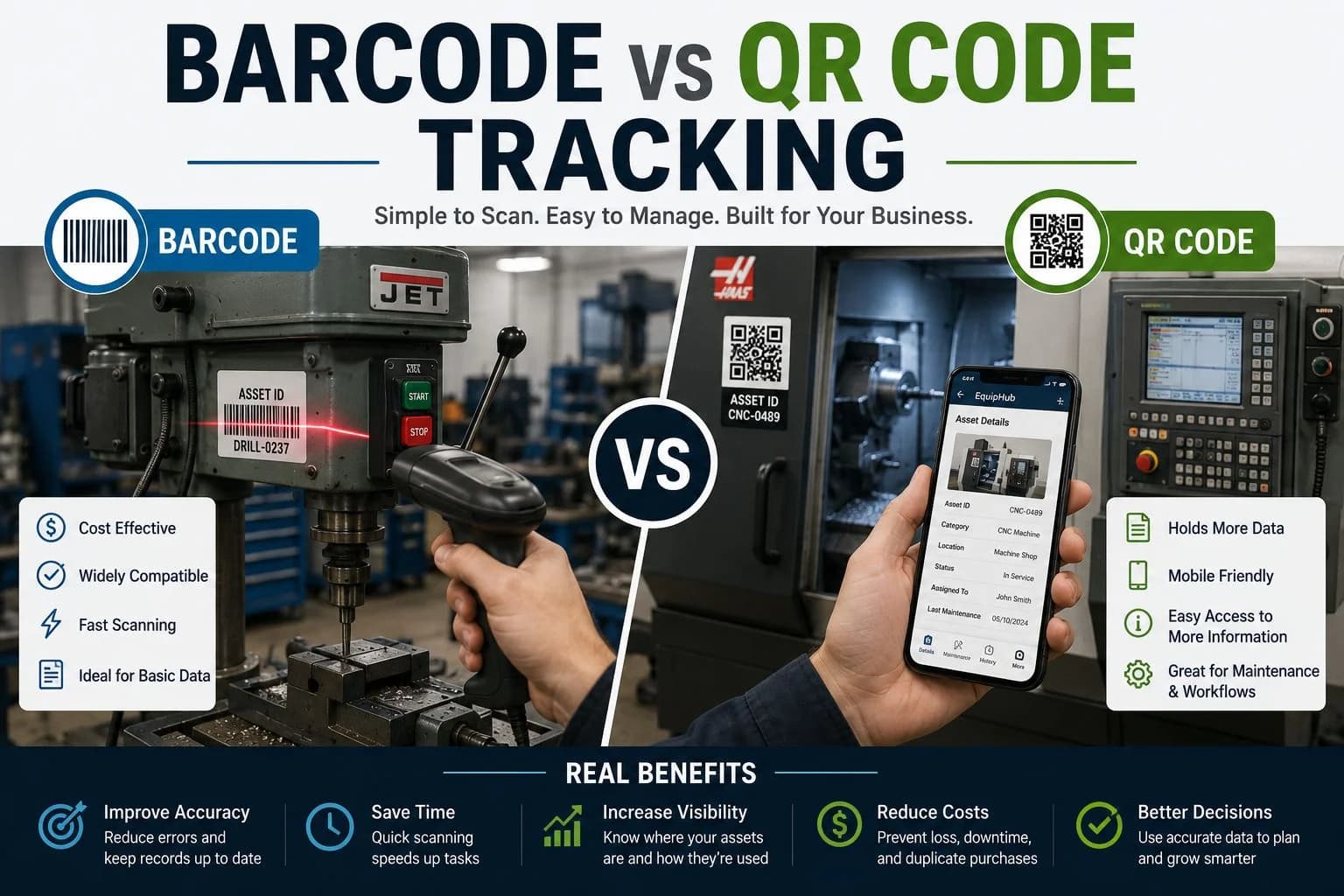
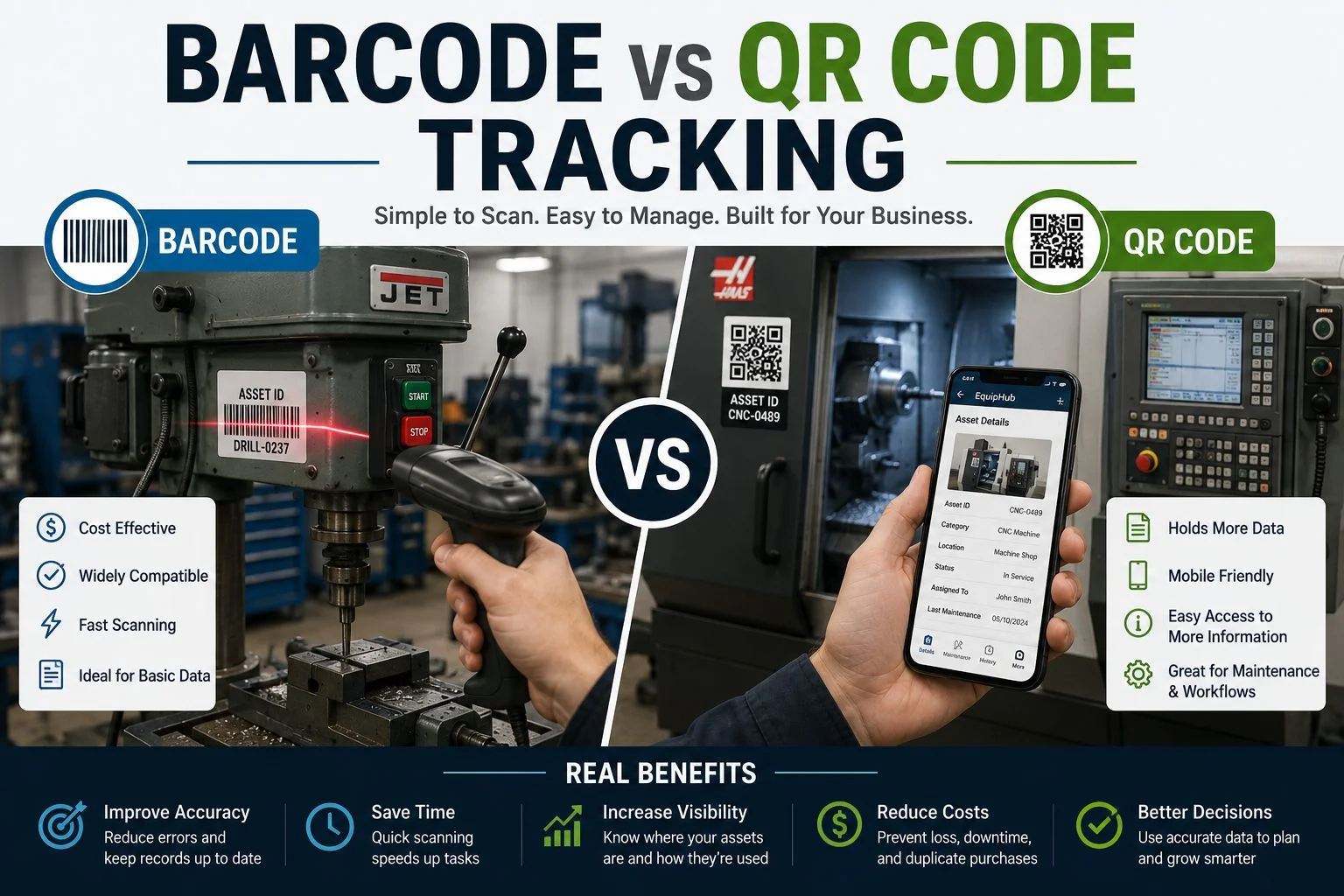
Asset tracking systems rely on accurate identification methods to monitor equipment throughout its lifecycle. Two of the most common technologies used for equipment tracking are barcodes and QR codes.
Both solutions allow businesses to identify, track, and manage equipment efficiently. However, each technology has unique advantages and limitations that can affect how well it fits your organization's needs.
Whether you manage construction equipment, manufacturing machinery, tools, vehicles, medical devices, or office assets, understanding the differences between barcodes and QR codes can help you choose the right tracking solution.
This guide explains how barcode and QR code tracking works, compares their strengths and weaknesses, and provides recommendations for selecting the best option for your business.
What Is Barcode Tracking?
A barcode is a machine-readable representation of data using a series of parallel lines and spaces.
Barcodes are commonly used to identify:
- Equipment
- Inventory
- Products
- Tools
- Fixed assets
Each barcode corresponds to a unique record within an asset management system.
When scanned, the barcode retrieves information associated with that asset.
How Barcode Tracking Works
The process is straightforward:
- Assign a unique asset ID.
- Generate a barcode label.
- Attach the label to the equipment.
- Scan the barcode using a scanner or mobile device.
- Access or update asset information in the tracking system.
Barcodes do not typically store large amounts of information themselves. Instead, they serve as a reference to records stored in a database.
Benefits of Barcode Tracking
Low Cost
Barcode labels are inexpensive to produce.
Organizations can print thousands of labels at minimal cost.
Simple Implementation
Most businesses are already familiar with barcode technology.
Training requirements are minimal.
Fast Scanning
Barcode scanners can read labels almost instantly.
This makes them useful for:
- Inventory counts
- Equipment checkouts
- Warehouse operations
Widely Supported
Barcode technology has been around for decades.
Virtually every asset management system supports barcode integration.
Limitations of Barcode Tracking
Limited Data Capacity
Traditional barcodes can only store a small amount of information.
Most often they contain:
- Asset numbers
- Product codes
- Reference identifiers
Additional information must be stored elsewhere.
Requires Direct Line of Sight
The scanner must typically align directly with the barcode.
Damaged or partially obscured labels can become difficult to scan.
Less Flexible
Barcodes primarily function as identifiers and offer limited interaction opportunities beyond retrieving records.
What Is QR Code Tracking?
A QR (Quick Response) code is a two-dimensional barcode capable of storing significantly more information.
Unlike traditional barcodes, QR codes can hold:
- Asset IDs
- Serial numbers
- URLs
- Contact information
- Maintenance instructions
- Equipment details
QR codes are becoming increasingly popular in modern asset management systems.
How QR Code Tracking Works
The process is similar to barcode tracking:
- Create a unique asset record.
- Generate a QR code.
- Attach the code to equipment.
- Scan using a smartphone or scanner.
- Access asset information instantly.
Many QR codes can direct users to a digital asset profile, maintenance record, or equipment history page.
Benefits of QR Code Tracking
Greater Data Capacity
QR codes can store substantially more information than traditional barcodes.
This allows businesses to embed:
- Asset information
- Inspection records
- Maintenance procedures
- Equipment manuals
- Website links
within the code itself.
Smartphone Friendly
Most modern smartphones can scan QR codes without special hardware.
Employees can simply use their mobile devices.
This reduces hardware costs and simplifies deployment.
Faster Access to Information
QR codes can connect directly to:
- Equipment records
- Service histories
- Maintenance schedules
- User manuals
Users can access information with a single scan.
Better Error Correction
QR codes include built-in error correction.
Even if part of the label becomes damaged, the code can often still be read successfully.
Improved User Experience
Because QR codes can launch webpages and applications, they create a more interactive asset management experience.
Users can instantly:
- View records
- Submit inspections
- Report issues
- Update asset statuses
from their mobile devices.
Limitations of QR Code Tracking
Slightly Larger Labels
QR codes often require more physical space than simple barcodes.
This may be a consideration for very small assets.
More Information Can Create Complexity
The additional capabilities of QR codes require planning and proper system design.
Without organization, excessive information can become difficult to manage.
Dependence on Digital Systems
Many QR implementations rely on internet-connected applications and cloud-based asset management platforms.
Barcode vs QR Code Comparison
Data Storage
Barcode:
- Limited data capacity
- Primarily identification numbers
QR Code:
- Significantly larger data capacity
- Can store detailed information
Winner: QR Code
Ease of Scanning
Barcode:
- Requires proper alignment
- Often needs dedicated scanners
QR Code:
- Easily scanned by smartphones
- Can be read from multiple angles
Winner: QR Code
Cost
Barcode:
- Slightly cheaper
- Simpler labels
QR Code:
- Still inexpensive
- Minimal cost difference for most businesses
Winner: Barcode (slight advantage)
Flexibility
Barcode:
- Primarily identification only
QR Code:
- Supports links, forms, records, manuals, and maintenance data
Winner: QR Code
Durability
Barcode:
- Damage can make scanning difficult
QR Code:
- Built-in error correction improves readability
Winner: QR Code
Ease of Adoption
Barcode:
- Familiar to most organizations
QR Code:
- Growing rapidly but may require minor process changes
Winner: Barcode
When Barcode Tracking Makes Sense
Barcode tracking is often ideal when:
- Equipment inventories are simple
- Budgets are extremely limited
- Existing systems already use barcodes
- Dedicated scanners are available
- Asset records are maintained separately
Many warehouses and inventory systems continue to rely successfully on barcode technology.
When QR Code Tracking Makes Sense
QR codes are often the better choice when:
- Mobile devices are used in the field
- Maintenance history needs quick access
- Equipment records are digital
- Employees work across multiple locations
- Self-service access is desired
Modern equipment management platforms increasingly use QR codes because of their flexibility and ease of use.
Best Practices for Asset Labeling
Regardless of which technology you choose:
Use Durable Labels
Equipment often faces:
- Dirt
- Moisture
- Chemicals
- Heat
- Physical wear
Choose industrial-grade labels when appropriate.
Assign Unique Asset IDs
Every asset should have a unique identifier.
Avoid using equipment names as identifiers.
Standardize Data
Use consistent naming conventions and record structures.
Consistency improves reporting and searchability.
Test Labels Regularly
Include label verification during inventory audits.
Replace damaged labels immediately.
Maintain Accurate Records
The label is only as useful as the data behind it.
Keep asset information updated.
Which Tracking Method Should You Choose?
For most modern businesses, QR code tracking offers the greatest long-term value.
QR codes provide:
- More flexibility
- Better mobile support
- Easier access to information
- Improved user experience
- Greater scalability
Traditional barcodes remain effective for simple inventory environments, but QR codes are often better suited for today's digital asset management systems.
Conclusion
Both barcode and QR code tracking can significantly improve equipment management and inventory accuracy. The right choice depends on your organization's needs, budget, and operational processes.
If your goal is simply identifying assets, barcodes may be sufficient. However, if you want to connect equipment to maintenance records, inspections, manuals, and digital workflows, QR codes provide a more powerful and future-ready solution.
As businesses continue adopting mobile technology and cloud-based asset management platforms, QR code tracking is becoming the preferred solution for organizations seeking greater visibility, efficiency, and control over their equipment.